Walk In Cooler Repair in Denver, CO
Walk in cooler repair typically runs $150–$1,200 nationally, per our cost guide. Independent local pros serving RiNo, LoDo, LoHi and nearby areas. Describe the problem and we'll route your request — free, no obligation.
- Walk-in coolers, freezers, reach-ins, prep tables & ice machines
- Mark emergencies and after-hours needs on the request
- Independent local commercial refrigeration providers
- No obligation — describe the problem, get a callback
Fast response from independent local providers. No obligation.
Typical national cost$150 – $1,200Cost guide →Local Help in Denver, CO
Three Denver offices touch a walk-in cooler. Community Planning and Development (CPD) certifies refrigeration supervisors and issues permits, the Department of Public Health & Environment (DDPHE) inspects kitchens, and the Department of Licensing and Consumer Protection issues retail food licenses. On cost, Vixxo's 2025 regional pricing guide gives $100 to $1,200 as the range for a typical single walk-in repair.
The 2025 Denver Building Code draws the line between a repair and a project. Its section 130.3.1 says no mechanical permit is required for general repairs and replacements of like units unless the work disconnects and reconnects one of five listed items, and a refrigerant line is one of them. A brand-new walk-in goes further: CPD's Quick Permits page sends walk-in coolers and freezers to Building Log review, with plans signed and stamped by a licensed design professional or professional engineer.
For the box itself, DDPHE's Food Safety System Toolkit tells Denver operators to hold cold food at 41°F or colder and to set refrigeration units at 35°F to 37°F so food stays there. The toolkit also requires a calibrated probe-type food thermometer reading from 0°F to 220°F, used every day. That 41°F line is the cold-holding limit in section 3-501.16(A)(2) of the 2022 FDA Food Code, the edition Colorado's retail food rules incorporate by reference.
Denver Service Details
What providers in this area actually see: coverage, common jobs, local pricing factors, and rules worth knowing.
Service Area Notes
- This guide covers work inside the City and County of Denver. Aurora, Lakewood, Arvada, Westminster and other neighboring cities run their own contractor licensing and permit offices, so a Denver certificate or permit route does not carry over automatically.
- Tell the contractor whether the box stores food for a restaurant or grocery, or cools beer or other product for a brewery or warehouse; the retail food license and DDPHE rules apply to food storage.
- Airport concessions and the large warehouse districts are covered in the Denver County guide, and statewide rules are in the Colorado guide.
Common Jobs in Denver
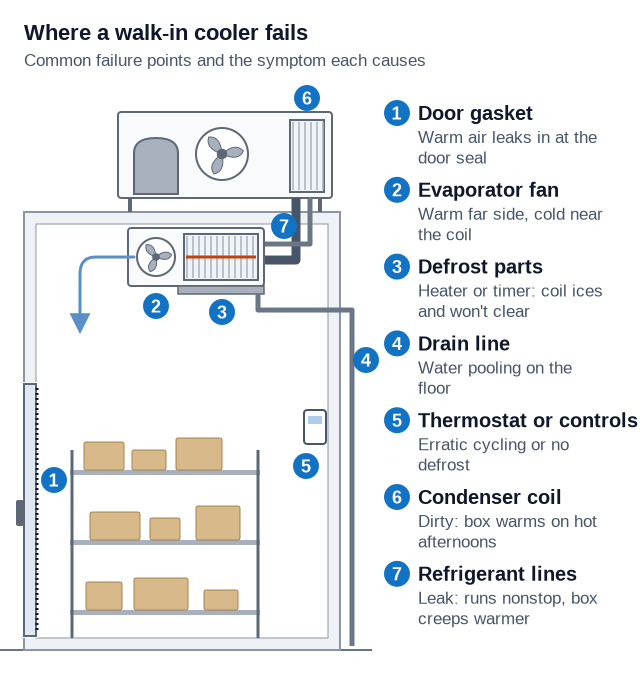
- Refrigerant leak repairs where the line is opened, which takes the job outside Denver's like-for-like permit exemption
- Like-for-like swaps of fan motors, controls and thermostats
- Controller calibration checked against a probe reading of stored food
- Freezer defrost heater, timer and drain-line repairs
- Building Log plan coordination for a new or relocated walk-in
What Drives Pricing Here
- Method: Denver dollar figures here come from Vixxo's 2025 guide for grocery retailers, which places the West with the Northeast among the regions with higher hourly rates and service fees and reports $100 to $1,200 for most single repairs.
- Critical failures: a breakdown that spoils product, needs rush parts and runs into overtime lands at $2,500 to $8,000 in Vixxo's estimate, and the guide adds that emergency work carries 25 to 50 percent overtime premiums.
- Maintenance: Vixxo's guide puts the entry price of basic annual PM at about $125 per unit.
- Permit line: when a repair disconnects and reconnects a refrigerant line, section 130.3.1 of the Denver code no longer exempts it, so ask whether the quote includes the mechanical permit.
- Design cost: a new walk-in cannot use a CPD quick permit, and the stamped plans required for Building Log review add design work that a parts repair does not need.
- Leak rules: EPA's January 2026 fact sheet says leak repair requirements now apply to appliances holding 15 pounds or more of HFC refrigerant, with a 20 percent leak-rate trigger for commercial refrigeration, a leak-rate calculation each time refrigerant is added, and 30 days to repair once the trigger is exceeded.
Permits & Local Rules
- CPD's mechanical certificates page lists the Refrigeration Class A Supervisor certificate for commercial and residential refrigeration, requiring eight years of commercial refrigeration installation work and ICC exam F29. The Class B certificate is residential only, limited to systems of 5 tons or less in one- and two-family dwellings, townhouses and Group U occupancies.
- The same page says a Refrigeration Journeyman may work only in the employ of a Refrigeration Contractor Class A or B. Ask which certified supervisor is responsible for your job.
- Denver adopted the 2025 Denver Building and Fire Codes on June 13, 2025. CPD says they incorporate the 2024 International Codes, except the energy code, which incorporates the 2021 IECC.
- Retail food license: the Department of Licensing and Consumer Protection lists a $150 application fee and builds the license fee by adding $25 for each listed activity, one of which is heating commercially processed foods or cold holding foods. The page cites Denver Revised Municipal Code sections 23-2, 23-40 and 32-75.
- Step 1: Probe stored food and note the time. Step 2: Ask for the supervisor's CPD refrigeration certificate and the technician's EPA Section 608 certification. Step 3: Ask whether the repair will open a refrigerant line; if so, plan for a mechanical permit. Step 4: For a new or relocated box, plan for Building Log review with stamped plans. Step 5: Resume the daily thermometer checks DDPHE's toolkit expects.
Climate & Equipment Notes
- NWS Boulder's July climate page lists Denver normal highs of 88°F on July 1 and 90°F on July 31, normal lows of 58°F and 61°F, and a July mean of 75.1°F, all from 1991–2020 data.
- Its January page shows normal highs of 44°F with lows of 18°F to 19°F, and records -29°F on January 9, 1875 as the lowest temperature in Denver history. Before buying or relocating an outdoor condensing unit, check the manufacturer's rated operating limits and any low-ambient or head-pressure controls the unit needs.
- Colorado's HFC Phase-Out Rule, AQCC Regulation 22, Part B, phased out listed HFCs in new and retrofitted remote condensing units and new stand-alone medium- and low-temperature units by January 1, 2021, according to CDPHE's fact sheet. The same date applies to rigid polyurethane foam in commercial refrigeration and sandwich panels, so confirm compliance before buying a replacement condensing unit or new panels.
- Climate normals are historical averages, not design temperatures; size equipment from site conditions and manufacturer data.
Neighborhoods & Suburbs Served
RiNo · LoDo · LoHi · Five Points · Capitol Hill · Baker / Santa Fe · Cherry Creek · Aurora · Lakewood · Golden · Westminster · Arvada · Littleton · Centennial
Emergency Response Expectations
When a Denver walk-in starts warming, probe the food, write down the time and reading, keep the door closed and move product to working refrigeration. DDPHE answers questions about food that sat above 41°F; CPD answers permit questions if an emergency replacement is needed.
Denver FAQs
Does fixing a Denver walk-in need a mechanical permit?
Not for general repairs or like-for-like replacements under section 130.3.1 of the 2025 Denver Building Code, unless the work disconnects and reconnects a refrigerant line or another listed item. A compressor swap that opens the line falls outside that exemption.
Can a new walk-in in Denver use a quick permit?
No. CPD lists walk-in coolers and freezers among projects that cannot be permitted as quick permits. They go through Building Log review in E-permits with plans signed and stamped by a licensed design professional or professional engineer.
Which Denver refrigeration certificate covers restaurant work?
The Refrigeration Class A Supervisor certificate, which CPD says covers commercial and residential work. Class B is limited to residential systems of 5 tons or less.
What thermostat setting does DDPHE suggest for a cooler?
Its toolkit says to set refrigeration units at 35°F to 37°F so food stays at 41°F or colder, and to check food temperatures daily with a calibrated probe thermometer.
Does cold holding change a Denver retail food license fee?
Yes. The license fee adds $25 for each listed activity, and cold holding foods is one of them. A new license also carries a $150 application fee.
What do Denver walk-in repairs cost?
In Vixxo's 2025 guide, a typical single repair runs $100 to $1,200 and a critical failure $2,500 to $8,000; the guide also places the West among the regions with higher hourly rates.
Sources
- Denver Community Planning and Development: Mechanical certificates (Refrigeration Class A and Class B Supervisor, Journeyman)
- Denver Community Planning and Development: Quick Permits (walk-in coolers/freezers sent to Building Log review)
- Denver Community Planning and Development: Building Codes, Policies and Guides (2025 Denver Building and Fire Codes)
- 2025 Denver Building Code, section 130.3.1 (mechanical permit exemptions)
- Denver Department of Public Health & Environment: Food Safety System Toolkit (2023)
- Denver Department of Licensing and Consumer Protection: New retail food license (application fee and per-activity fees)
- NWS Boulder: Denver climate records for July (1991–2020 normals)
- NWS Boulder: Denver climate records for January (1991–2020 normals, record low)
- CDPHE Air Pollution Control Division: HFC phase-out rule (AQCC Regulation 22, Part B) and fact sheet
- EPA: AIM Act leak repair requirements fact sheet, 40 CFR Part 84 (January 2026)
- FDA: Food Code 2022 (section 3-501.16, cold holding at 41°F)
- CDPHE: Retail food resources (2024 Colorado Retail Food Establishment Regulations, 6 CCR 1010-2, effective March 16, 2024, incorporating the 2022 FDA Food Code)
- EPA: Section 608 technician certification
- Vixxo: 2025 Regional Guide to Commercial Refrigeration Repair Pricing for Grocery Retailers (Dec. 17, 2025) (third-party estimate)
Last reviewed 2026-10-20
Services Available in Denver
Walk-In Cooler Repair
Warm box, iced-up evaporator, or a compressor that won't kick on — request urgent walk-in cooler repair from local commercial refrigeration techs.
Learn more →Commercial Freezer Repair
Walk-in freezers, reach-ins, and chest freezers losing temp — get routed to local techs who handle commercial freezer failures fast.
Learn more →Restaurant Refrigeration Repair
Prep tables, reach-ins, walk-ins, and line refrigeration for restaurants — one request covers every cold-side unit in your kitchen.
Learn more →Emergency Refrigeration Repair
After-hours, weekends, holidays — request urgent routing to local commercial refrigeration techs when a unit fails with product inside.
Learn more →Ice Machine Repair
Commercial ice makers that stopped producing, run slow, or make bad ice — get connected with local techs for Hoshizaki, Manitowoc, Scotsman and more.
Learn more →Commercial Refrigeration Service
Preventive maintenance, refrigerant compliance, and multi-unit service programs for restaurants, groceries, and food-service operators.
Learn more →Free Tools Before You Call
Ballpark the cost or narrow down the problem before talking to a Denver provider.
Walk-In Cooler Not Cooling — Diagnostic Tool
Walk-in warm and product at risk? Answer a few questions to find the likely fault, what it costs to fix, and whether you need a tech now.
Use the free tool →Is My Food Still Safe? Walk-In Cooler-Down Calculator
Walk-in stopped cooling? Get a keep / cook-now / discard verdict from FDA Food Code rules — and know exactly how long you have.
Use the free tool →Walk-In Cooler Repair Cost Estimator
Pick the suspected fault and get an honest low–high repair estimate — parts, labor, service call, and after-hours premium itemized.
Use the free tool →Need help in Denver, CO?
Send the short form — urgent requests get priority routing.