Walk In Cooler Repair in Nashville, TN
Walk in cooler repair typically runs $150–$1,200 nationally, per our cost guide. Independent local pros serving Lower Broadway, The Gulch, SoBro and nearby areas. Describe the problem and we'll route your request — free, no obligation.
- Walk-in coolers, freezers, reach-ins, prep tables & ice machines
- Mark emergencies and after-hours needs on the request
- Independent local commercial refrigeration providers
- No obligation — describe the problem, get a callback
Fast response from independent local providers. No obligation.
Typical national cost$150 – $1,200Cost guide →Local Help in Nashville, TN
Vixxo's 2025 regional guide puts most single walk-in repairs at $100 to $1,200, far below the $25,000 project value at which the Tennessee Board for Licensing Contractors requires a state contractor license, so Metro Codes' local trade rules matter most for a routine Nashville repair.
In Nashville and Davidson County, Metro Codes and Building Safety handles trade licensing and permit questions, and Metro Public Health Department's Food Protection Services inspects restaurants, snack bars, and school cafeterias. A cooler breakdown and a replacement project involve different questions for those offices.
NWS Nashville lists a July normal average high of 90.9°F and low of 70.5°F. For an outdoor condenser problem, report when the temperature rises and which controls or fans stop, rather than assuming a summer symptom proves compressor failure.
Nashville Service Details
What providers in this area actually see: coverage, common jobs, local pricing factors, and rules worth knowing.
Service Area Notes
- Nashville service routes run on I-40, I-65 and I-24, which meet around downtown, with Briley Parkway linking Opryland and the airport hotels. Ask for a dock or alley stop on Lower Broadway, where curb space is scarce.
- Identify Davidson County versus a surrounding county on a Nashville-area request so the correct building and food authorities can be consulted.
- Describe beverage storage, restaurant food storage, or process cooling separately; the temperature requirements and contractor scope can differ.
Common Jobs in Nashville
- Nashville restaurant walk-in capacity checks against recorded summer operating conditions
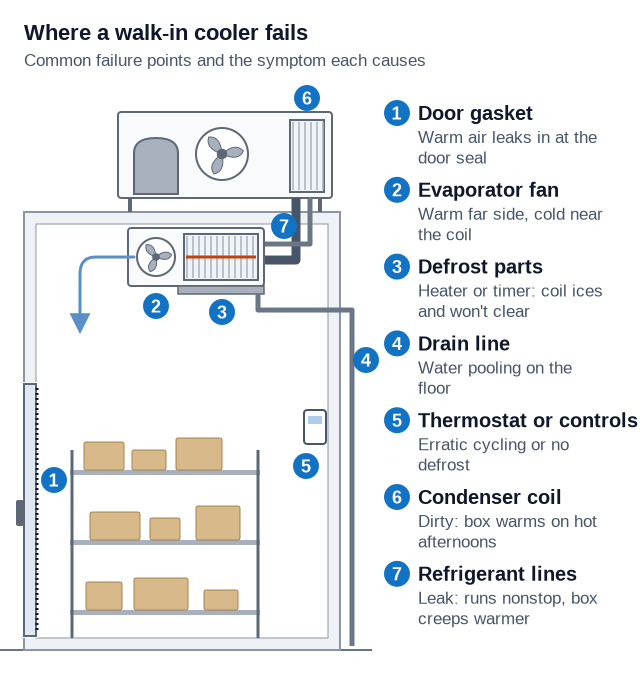
- Freezer evaporator fan and defrost control diagnosis
- Cold-room sensor and door repairs with food-temperature verification
- Refrigerant leak search and repair with recovery by a certified technician
What Drives Pricing Here
- Method: Nashville figures are based on Vixxo's published 2025 guide, which reports most single repairs at $100 to $1,200 and places the South among the lower-cost regions for labor.
- Emergencies: Vixxo says emergency calls commonly cost two to three times a planned repair and that critical failures average $2,500 to $8,000 with product loss included; a weekend failure on Broadway is the expensive case.
- Project size: the Tennessee Board for Licensing Contractors requires a license, such as CMC-C, before contracting on mechanical or HVAC work of $25,000 or more, so a full walk-in replacement may cross that line while most repairs fall well below it.
- The Tennessee Board for Licensing Contractors identifies CMC-C as HVAC, Refrigeration and Gas Piping, and licenses carry a monetary limit. For a larger Nashville equipment project, have the contractor confirm the applicable classification and authorized project limit.
- Metro Codes is responsible for local trade licensing, inspections, and permit applications. Include the needed trade coordination in a replacement proposal; state licensing does not settle every local requirement.
- A Nashville repair quote should distinguish fault diagnosis from an equipment redesign. NWS's 90.9°F July normal high is useful context but cannot establish a particular cold room's capacity requirement.
Permits & Local Rules
- As of October 2026, check CMC-C or other applicable scope with the Tennessee Board for Licensing Contractors and the local trade credential with Metro Codes and Building Safety. State licensing thresholds and the proposed project value need confirmation; do not describe every minor repair as requiring the same state license.
- Tennessee Department of Health food-service rule 1200-23-01-.03 sets a general cold-holding limit of 41°F or less for TCS food, with specified exceptions. Metro Public Health Department Food Protection Services is the inspection contact for Davidson County restaurant operations.
- Tennessee licensing: the Tennessee Board for Licensing Contractors requires a license before bidding or contracting on projects of $25,000 or more, including subcontractors whose HVAC or mechanical portion reaches $25,000. Tenn. Code Ann. § 68-14-718 separately requires plan approval before a food service establishment is extensively remodeled, which the Act defines to include installing new equipment.
- Step 1: Record product temperatures and the time the box began warming. Step 2: Check the contractor's Metro Codes trade credential and, for larger projects, the state CMC-C classification. Step 3: Ask Metro Codes whether the equipment change needs a mechanical permit. Step 4: For new equipment that changes the kitchen, ask Metro Public Health about plan review. Step 5: Approve a written scope and keep the temperature log.
Climate & Equipment Notes
- NWS Nashville's normal table pairs July's 90.9°F high with January's 30.1°F low. When a condenser operates outdoors year-round, ask how its controls address both hot afternoons and cold-weather operation.
- Metro Food Protection's restaurant oversight makes the food-temperature record central to an outage response. Restoring refrigeration and deciding whether food remains usable are separate determinations.
- Restaurants and bars along Lower Broadway and in the Gulch south of downtown pack heavy door traffic into long nights, which strains gaskets and evaporator fans.
- Summer heat and humidity across the suburbs also push rooftop condensers on grocers, and spring storms can bring power outages that interrupt cold holding.
Neighborhoods & Suburbs Served
Lower Broadway · The Gulch · SoBro · Midtown · Germantown · East Nashville · 12South · Berry Hill · Franklin · Brentwood · Murfreesboro · Hendersonville
Emergency Response Expectations
For Nashville restaurant emergencies, record readings and times before and after transferring food to working refrigeration. Ask the provider for a confirmed service window and Metro Food Protection for unresolved food-safety questions.
Nashville FAQs
Which Tennessee classification includes refrigeration?
The Board for Licensing Contractors lists CMC-C for HVAC, Refrigeration and Gas Piping. Confirm the firm's classification, monetary limit, and whether your project meets state licensing thresholds; Metro Codes also administers local trade requirements.
Who inspects Nashville restaurants after a cold-holding concern?
Metro Public Health Department Food Protection Services covers Davidson County food service establishments. Tennessee's general TCS cold-holding standard is 41°F or less; supply the inspector with actual food readings and the time history.
How much does walk-in cooler repair cost in Nashville?
Vixxo's 2025 guide puts most single repairs at $100 to $1,200 and critical failures with product loss at $2,500 to $8,000. Emergency calls commonly cost two to three times a planned visit.
When does a Tennessee walk-in project need a state contractor license?
The Tennessee Board for Licensing Contractors requires one for projects of $25,000 or more, including subcontracted HVAC or mechanical portions at that value. Smaller jobs still follow Metro Codes rules.
Sources
- Tennessee Board for Licensing Contractors — Classification outline
- Metro Nashville — Codes and Building Safety
- Metro Public Health — Food Protection Services
- Tennessee Department of Health — Food Service Establishment rules
- NWS Nashville — Climate normals and records
- Vixxo: 2025 Regional Guide to Commercial Refrigeration Repair Pricing for Grocery Retailers (Dec. 17, 2025) (third-party estimate)
- Tennessee Board for Licensing Contractors: Contractor license requirements ($25,000 threshold)
- Tennessee Food Safety Act, Tenn. Code Ann. § 68-14-701 et seq. (Tennessee Department of Health)
Last reviewed 2026-10-16
Nearby Counties
Services Available in Nashville
Walk-In Cooler Repair
Warm box, iced-up evaporator, or a compressor that won't kick on — request urgent walk-in cooler repair from local commercial refrigeration techs.
Learn more →Commercial Freezer Repair
Walk-in freezers, reach-ins, and chest freezers losing temp — get routed to local techs who handle commercial freezer failures fast.
Learn more →Restaurant Refrigeration Repair
Prep tables, reach-ins, walk-ins, and line refrigeration for restaurants — one request covers every cold-side unit in your kitchen.
Learn more →Emergency Refrigeration Repair
After-hours, weekends, holidays — request urgent routing to local commercial refrigeration techs when a unit fails with product inside.
Learn more →Ice Machine Repair
Commercial ice makers that stopped producing, run slow, or make bad ice — get connected with local techs for Hoshizaki, Manitowoc, Scotsman and more.
Learn more →Commercial Refrigeration Service
Preventive maintenance, refrigerant compliance, and multi-unit service programs for restaurants, groceries, and food-service operators.
Learn more →Free Tools Before You Call
Ballpark the cost or narrow down the problem before talking to a Nashville provider.
Walk-In Cooler Not Cooling — Diagnostic Tool
Walk-in warm and product at risk? Answer a few questions to find the likely fault, what it costs to fix, and whether you need a tech now.
Use the free tool →Is My Food Still Safe? Walk-In Cooler-Down Calculator
Walk-in stopped cooling? Get a keep / cook-now / discard verdict from FDA Food Code rules — and know exactly how long you have.
Use the free tool →Walk-In Cooler Repair Cost Estimator
Pick the suspected fault and get an honest low–high repair estimate — parts, labor, service call, and after-hours premium itemized.
Use the free tool →Need help in Nashville, TN?
Send the short form — urgent requests get priority routing.