Walk-In Cooler Repair
Warm box, iced-up evaporator, or a compressor that won't kick on — request urgent walk-in cooler repair from local commercial refrigeration techs.
- Walk-in coolers, freezers, reach-ins, prep tables & ice machines
- Mark emergencies and after-hours needs on the request
- Independent local commercial refrigeration providers
- No obligation — describe the problem, get a callback
Fast response from independent local providers. No obligation.
Typical national cost$150 – $1,200Cost guide →About Walk-In Cooler Repair
A walk-in cooler that creeps above 41°F isn't an inconvenience — it's inventory loss on a timer and a health-inspection risk. Whether you run a restaurant, grocery, convenience store, or commercial kitchen, every hour a warm box sits unrepaired costs you product.
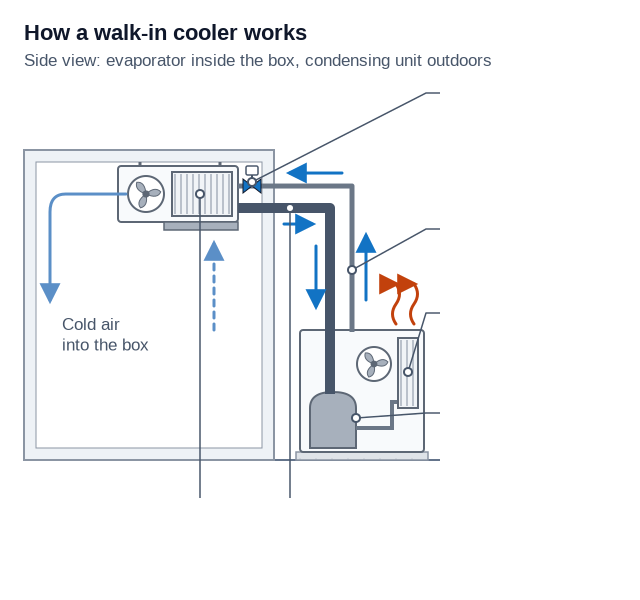
Walk-in cooler work covers compressors, condensers, evaporator coils, door gaskets, defrost timers, and refrigerant leaks. Describe the symptom, and we pass your request to independent local refrigeration technicians.
Common Jobs We Route
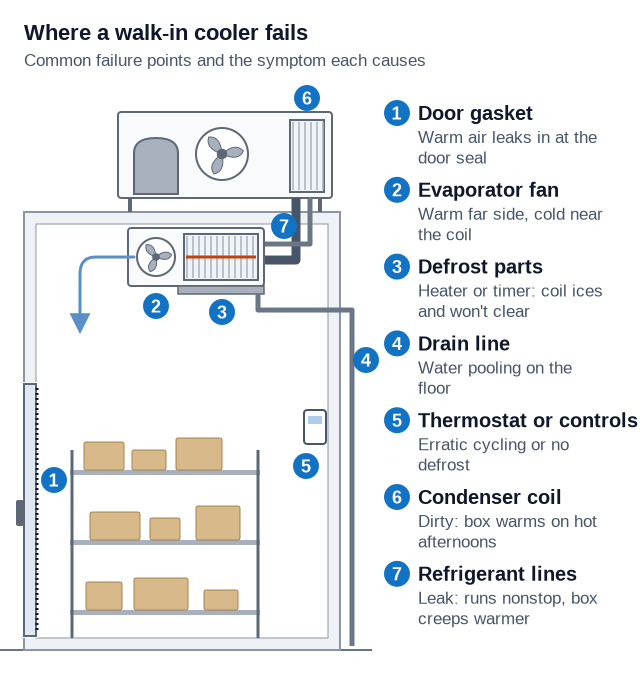
- Walk-in cooler not holding temperature / warm box
- Compressor not starting, short-cycling, or running constantly
- Iced-up or frozen evaporator coil
- Refrigerant leak diagnosis and repair
- Water leaking inside or under the box
- Door gasket, hinge, and sweep replacement
- Defrost timer and thermostat failures
- Condenser coil cleaning and airflow problems
What Affects the Price
Providers quote their own work — these are the factors that consistently move the number.
- Diagnosis vs. repair: most providers charge a diagnostic/trip fee that's credited toward the repair
- Compressor replacement is the big-ticket item — condensing unit size and refrigerant type drive the quote
- Refrigerant type matters: legacy R-22 systems cost more to recharge than R-448A/R-449A retrofits
- After-hours, weekend, and holiday calls typically carry an emergency rate
- Roof-mounted or hard-to-access condensing units add labor time
- Age of the box: older panels and obsolete parts can push repair toward replacement
How It Works
- Step 1
Describe the symptom
Warm box, ice buildup, noise, leak — the more specific, the better the routing.
- Step 2
Get connected
Your request goes to an independent local commercial refrigeration provider covering your area.
- Step 3
Diagnostic visit
The tech confirms the failure, quotes the repair, and can often stabilize temps the same visit.
- Step 4
Repair & verify
Repair is completed and the box is verified to hold temp before the tech leaves.
Free Walk-In Cooler Repair Tools
Get a realistic number or a quick diagnosis first — free, built on published industry data.
Walk-In Cooler Not Cooling — Diagnostic Tool
Walk-in warm and product at risk? Answer a few questions to find the likely fault, what it costs to fix, and whether you need a tech now.
Use the free tool →Walk-In Cooler Repair Cost Estimator
Pick the suspected fault and get an honest low–high repair estimate — parts, labor, service call, and after-hours premium itemized.
Use the free tool →Cost Guides
In an emergency?
Walk-In Cooler Repair FAQs
My walk-in is warm but the compressor is running. What's wrong?
Common culprits are an iced-up evaporator coil, a dirty condenser, low refrigerant from a leak, or a failed defrost cycle. A tech can usually isolate the cause in one diagnostic visit — describe whether you see ice, water, or hear the compressor cycling when you request help.
How fast can someone get here?
Response times depend on the provider covering your area and the time of day. Emergency requests are flagged for urgent routing — many commercial refrigeration providers run after-hours service specifically for warm-box calls.
Should I repair or replace my walk-in cooler?
A good rule of thumb: if the box is 15+ years old and the repair is a compressor or refrigerant system rebuild, ask for a replacement quote alongside the repair quote. Panel condition, refrigerant type, and energy use all factor in.
What should I do while I wait for the tech?
Keep the door closed, move high-risk product to a working unit if you have one, and log temperatures for your health-inspection records. Don't keep resetting the breaker — repeated hard starts can finish off a struggling compressor.
Walk-In Cooler Repair by Area
Need walk-in cooler repair?
Send the short form — no obligation.