Walk In Cooler Repair in Phoenix, AZ
Walk in cooler repair typically runs $150–$1,200 nationally, per our cost guide. Independent local pros serving Downtown Phoenix, Midtown, Arcadia and nearby areas. Describe the problem and we'll route your request — free, no obligation.
- Walk-in coolers, freezers, reach-ins, prep tables & ice machines
- Mark emergencies and after-hours needs on the request
- Independent local commercial refrigeration providers
- No obligation — describe the problem, get a callback
Fast response from independent local providers. No obligation.
Typical national cost$150 – $1,200Cost guide →Local Help in Phoenix, AZ
Vixxo's 2025 guide puts most single walk-in repairs at $100 to $1,200 but ranks the West among the highest-cost regions, and Maricopa County Environmental Services' new fee summary sets annual permits for eating and drinking establishments with 10 or more seats at $400 to $1,015.
Phoenix food operators can use Maricopa County Environmental Services' Cold Holding Toolbox to document temperatures and corrective action, while City of Phoenix Planning & Development handles commercial permitting questions. The food inspection and construction processes serve different purposes.
NWS Phoenix's 1991–2020 July normals are a 106.5°F average high and 84.5°F average low. Those values support a careful outdoor-condenser performance assessment without inventing rooftop temperatures or a fixed time until food becomes unsafe.
Phoenix Service Details
What providers in this area actually see: coverage, common jobs, local pricing factors, and rules worth knowing.
Service Area Notes
- Phoenix calls run along I-10 and I-17, which meet near downtown, plus Loop 101 and Loop 202 to Scottsdale, Tempe and the West Valley. Dispatch should know about roof access, since many strip-center condensers sit on flat roofs.
- Name Phoenix, Tempe, Mesa, Scottsdale, or the actual municipality when asking about permits; Phoenix Planning & Development only handles its own jurisdiction.
- Identify the condenser's mounting, shade, airflow clearance, and equipment model for a Valley refrigeration visit.
Common Jobs in Phoenix
- Phoenix condenser performance testing at the measured outdoor ambient
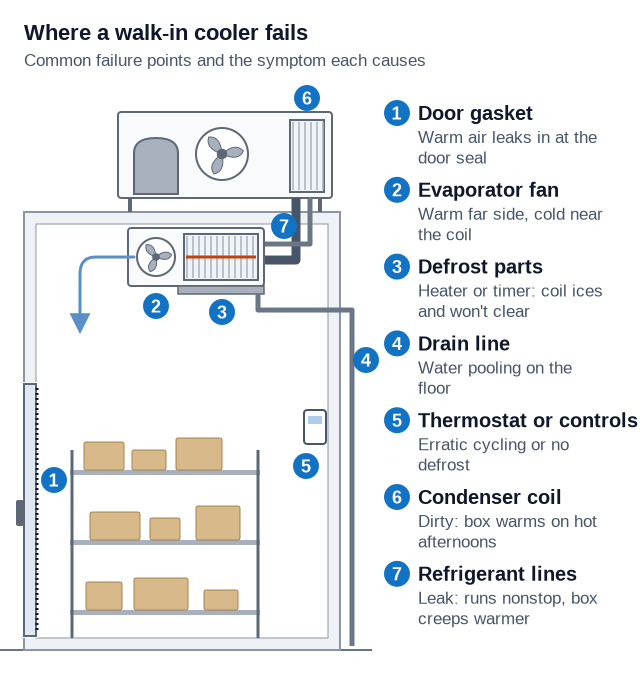
- Freezer temperature-control and defrost troubleshooting in commercial food storage
- Walk-in food-temperature verification using Maricopa cold-holding resources
- Preventive maintenance: condenser coil cleaning, drain-line clearing, and gasket checks
What Drives Pricing Here
- Method: Phoenix ranges are based on Vixxo's published 2025 guide, which says most single repairs run $100 to $1,200 and that the West and Northeast are consistently the highest-cost regions for labor.
- Emergencies: Vixxo lists $2,500 to $8,000 for a critical failure with overtime, expedited parts and product loss, and says after-hours calls commonly cost two to three times a planned visit.
- County fees: Maricopa County Environmental Services' fee summary lists $885 for plan review of an eating and drinking establishment with 10 or more seats, a local cost to ask about if a walk-in change triggers county review.
- Arizona Registrar of Contractors classification C-49 Refrigeration covers systems for processing, storing, and displaying food and other perishables, excluding comfort air conditioning. Compare Phoenix bids using a credential that covers the actual refrigeration scope.
- Phoenix Planning & Development's commercial contact and SHAPE PHX system support permit coordination. Ask whether electrical reconnection, equipment changes, and review are part of the written job scope.
- July's 106.5°F normal high and 84.5°F normal low make both daytime capacity and overnight recovery relevant. Specify manufacturer-rated ambient capacity when evaluating a replacement; a citywide average cannot justify a particular unit size or premium.
Permits & Local Rules
- Check an appropriate Arizona Registrar of Contractors license, such as commercial C-49 Refrigeration, for Phoenix food-storage equipment work. The official classification expressly covers food and perishable storage systems; match the credential to the planned tasks.
- As of October 2026, City of Phoenix Planning & Development should determine the permit requirements for your installation. Its published permitting system directs new commercial applications to SHAPE PHX; neighboring cities use their own processes.
- Maricopa County Environmental Services provides restaurant cold-holding policies, logs, and verification tools. County guidance requires TCS food at 41°F or below; use product readings to evaluate storage compliance rather than relying solely on a wall display.
- Maricopa County fees: the county's ES-2025-004 fee summary lists new annual operating permits for eating and drinking establishments with 10 or more seats from $400 (Class 2) to $1,015 (Class 4), and $885 for their plan review. Arizona's ROC C-49 license covers the refrigeration work itself.
- Step 1: Use Maricopa's Cold Holding Toolbox log to record product temperatures. Step 2: Confirm the contractor's ROC C-49 Refrigeration license and Section 608 certification. Step 3: Ask Phoenix Planning & Development whether the change needs a permit through SHAPE PHX. Step 4: Approve a written scope that lists the condenser's ambient rating. Step 5: Ask the county about plan review before changing the equipment layout.
Climate & Equipment Notes
- NWS's Phoenix July climate summary labels the 106.5°F high and 84.5°F low as 1991–2020 normals, distinct from observed temperatures. Ask the technician to measure the air reaching the condenser and check the equipment rating for that location.
- Maricopa's Cold Holding Toolbox includes policy, training, logging, and verification resources. Use those records during a Phoenix repair to distinguish an equipment problem from loading or operating practices that need correction.
- Restaurants along the Roosevelt Row arts district and in downtown Phoenix operate where summer heat stays extreme into the night, so condensers get little recovery time.
- Desert dust blown in by monsoon storms clogs coils in the suburbs, and the same storms can bring power outages.
Neighborhoods & Suburbs Served
Downtown Phoenix · Midtown · Arcadia · Camelback Corridor · Scottsdale · Old Town Scottsdale · Tempe · Mesa · Chandler · Gilbert · Glendale · Peoria
Emergency Response Expectations
For Phoenix hot-weather failures, send the current food readings, equipment identification, and condenser access details with the service request. Do not infer a safe waiting period from the outside temperature alone.
Phoenix FAQs
What does Arizona's C-49 refrigeration classification cover?
The Arizona Registrar of Contractors classification covers installation, alteration, and repair of refrigeration for processing, storage, and display of food and other perishables, including commercial and industrial processes. It excludes comfort air conditioning.
Where can a Phoenix kitchen get a cold-holding log?
Maricopa County Environmental Services' Cold Holding Toolbox links temperature logs and verification guidance. Record actual food temperatures against the county's 41°F-or-below TCS cold-holding guidance and ask the inspector about corrective action.
Why does walk-in cooler repair cost more in Phoenix?
Vixxo's 2025 guide ranks the West among the highest-cost regions for refrigeration labor. Most single repairs still fall between $100 and $1,200, while critical failures with product loss average $2,500 to $8,000.
What does a Maricopa County restaurant permit cost?
The county's fee summary lists new annual permits for eating and drinking establishments with 10 or more seats from $400 to $1,015 by class, and $885 for plan review.
Sources
- Arizona Secretary of State — Registrar of Contractors classifications, C-49
- Phoenix — Planning & Development commercial contact
- Phoenix — PDD Online and SHAPE PHX transition
- Maricopa County — Cold Holding Toolbox
- Maricopa County — TCS cold-holding requirements
- NWS Phoenix — July summary with 1991–2020 normals
- Vixxo: 2025 Regional Guide to Commercial Refrigeration Repair Pricing for Grocery Retailers (Dec. 17, 2025) (third-party estimate)
- Maricopa County Environmental Services: ES-2025-004 Environmental Health fee summary (current and new fees)
Last reviewed 2026-10-16
Nearby Counties
Services Available in Phoenix
Walk-In Cooler Repair
Warm box, iced-up evaporator, or a compressor that won't kick on — request urgent walk-in cooler repair from local commercial refrigeration techs.
Learn more →Commercial Freezer Repair
Walk-in freezers, reach-ins, and chest freezers losing temp — get routed to local techs who handle commercial freezer failures fast.
Learn more →Restaurant Refrigeration Repair
Prep tables, reach-ins, walk-ins, and line refrigeration for restaurants — one request covers every cold-side unit in your kitchen.
Learn more →Emergency Refrigeration Repair
After-hours, weekends, holidays — request urgent routing to local commercial refrigeration techs when a unit fails with product inside.
Learn more →Ice Machine Repair
Commercial ice makers that stopped producing, run slow, or make bad ice — get connected with local techs for Hoshizaki, Manitowoc, Scotsman and more.
Learn more →Commercial Refrigeration Service
Preventive maintenance, refrigerant compliance, and multi-unit service programs for restaurants, groceries, and food-service operators.
Learn more →Free Tools Before You Call
Ballpark the cost or narrow down the problem before talking to a Phoenix provider.
Walk-In Cooler Not Cooling — Diagnostic Tool
Walk-in warm and product at risk? Answer a few questions to find the likely fault, what it costs to fix, and whether you need a tech now.
Use the free tool →Is My Food Still Safe? Walk-In Cooler-Down Calculator
Walk-in stopped cooling? Get a keep / cook-now / discard verdict from FDA Food Code rules — and know exactly how long you have.
Use the free tool →Walk-In Cooler Repair Cost Estimator
Pick the suspected fault and get an honest low–high repair estimate — parts, labor, service call, and after-hours premium itemized.
Use the free tool →Need help in Phoenix, AZ?
Send the short form — urgent requests get priority routing.