Walk In Cooler Repair in Colorado, CO
Walk in cooler repair typically runs $150–$1,200 nationally, per our cost guide. Independent local pros serving Denver, Denver County, Denver International Airport and nearby areas. Describe the problem and we'll route your request — free, no obligation.
- Walk-in coolers, freezers, reach-ins, prep tables & ice machines
- Mark emergencies and after-hours needs on the request
- Independent local commercial refrigeration providers
- No obligation — describe the problem, get a callback
Fast response from independent local providers. No obligation.
Typical national cost$150 – $1,200Cost guide →Local Help in Colorado, CO
Vixxo's published 2025 regional guide puts most single walk-in repairs at $100 to $1,200, and in Colorado the bigger question is often who is allowed to do the work. DRCOG's June 2025 presentation on HVAC licensure notes that Colorado is one of 17 states without a statewide HVAC licensure program, so refrigeration contractors are licensed city by city.
That patchwork is real for contractors: DRCOG profiled one Front Range mechanical firm licensed in 20 jurisdictions. For a restaurant or grocer, it means the license to ask for depends on the address. In Denver, Community Planning and Development issues refrigeration supervisor certificates; other cities run their own building and licensing offices.
Food safety is statewide. The Colorado Department of Public Health and Environment's Retail Food Establishment Rules (6 CCR 1010-2), effective March 16, 2024, adopt the 2022 FDA Food Code, and local health agencies such as DDPHE inspect against them.
Colorado Service Details
What providers in this area actually see: coverage, common jobs, local pricing factors, and rules worth knowing.
Service Area Notes
- Local guides on this site: the Denver city page and the Denver County page. Each one names the Health department, the Building permit office and the refrigeration credential that apply there.
- The Denver city page covers neighborhood restaurants and breweries in RiNo, LoDo and the central districts. The Denver County page covers the airport, the warehouse districts along I-70 and I-25, and the large buildings that fall under Energize Denver.
Common Jobs in Colorado
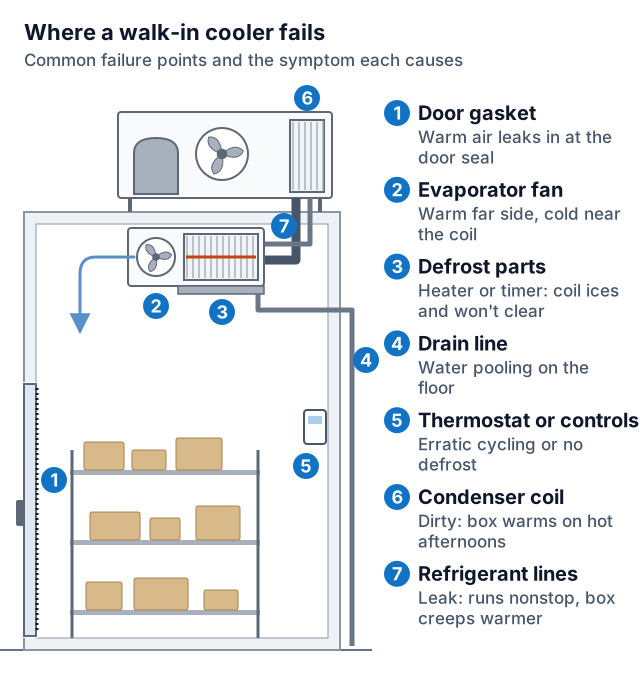
- Front Range condensers that cannot hold box temperature through a July afternoon
- Head-pressure and low-ambient control repairs on rooftop units before the first hard freeze
- Defrost heater, timer and drain-line faults that leave freezer coils packed with ice
- Strip curtains, door sweeps and self-closers on high-traffic kitchen walk-ins
- Leak searches and refrigerant recovery, handled only by EPA Section 608 certified technicians
What Drives Pricing Here
- Method: the dollar figures on this page are based on Vixxo's 2025 regional guide to commercial refrigeration repair pricing, which reports that most single walk-in repairs land between $100 and $1,200.
- West pricing: Vixxo groups the West with the Northeast as the most expensive regions for refrigeration labor and service fees, so Colorado quotes tend to sit toward the upper end of national ranges.
- Worst case: Vixxo puts a critical failure at $2,500 to $8,000 per incident when overtime, rush parts and spoiled product are added together.
- Planned service: Vixxo lists basic annual maintenance at roughly $125 per unit, the cheapest line item on this page.
- Licensing overhead: DRCOG notes there is no statewide HVAC license, so a contractor serving several Front Range cities keeps several local licenses current, and that overhead can show up in the price.
Permits & Local Rules
- Step 1: Check the local credential. Colorado has no statewide HVAC license, so ask for the license issued by the city where the walk-in sits; in Denver that is a CPD refrigeration supervisor certificate, with Class A for commercial work.
- Step 2: Confirm the technician's EPA Section 608 certification under 40 CFR Part 82 before the refrigerant circuit is opened.
- Step 3: For a new or replaced box, ask the local Building permit office which permit route applies; Denver CPD keeps walk-in coolers and freezers off its quick-permit list.
- Step 4: If product sat above 41°F, the cold-holding limit in Colorado's retail food rules (6 CCR 1010-2, adopting the 2022 FDA Food Code), get your local Health department's direction before serving it, and keep temperature logs for the inspector. In Denver, a box that adds a food activity can also touch the retail food license: Denver Excise and Licenses charges $25 per food-processing activity, plus a $150 application fee for a new license.
Climate & Equipment Notes
- Summer heat: NOAA's 1991-2020 normals for Denver International Airport average 46.2 days a year at 90°F or hotter, with a July normal high of 89.9°F, so Front Range condensers do most of their hard work in midsummer.
- Winter cold: NOAA's same normals put January lows near 18.7°F, which is why outdoor condensers on restaurants and grocery stores along the Front Range need low-ambient controls.
- Breweries: the brewery and taproom districts north of downtown Denver keep keg rooms cold around the clock all summer.
- Large buildings: Energize Denver requires benchmarking for buildings of 25,000 square feet or more, so walk-in efficiency in grocery stores and refrigerated warehouses also shows up in the building's energy report.
- Food sites: DDPHE reports more than 4,000 regulated retail food establishments in Denver alone.
Neighborhoods & Suburbs Served
Denver · Denver County · Denver International Airport · RiNo · LoDo
Emergency Response Expectations
If the box is warming, keep the door shut, move high-value product to another cooler and call a refrigeration contractor licensed in your city. Note the time and temperature for your records.
Colorado FAQs
Is there a Colorado state license for refrigeration work?
No. DRCOG notes Colorado is one of 17 states without a statewide HVAC licensure program, so licensing happens at the city level. Denver uses CPD refrigeration supervisor certificates.
What cold-holding temperature applies in Colorado?
The state's Retail Food Establishment Rules adopt the 2022 FDA Food Code, which sets 41°F or below for cold-held food.
What do Colorado walk-in repairs usually cost?
Vixxo's 2025 guide reports most single repairs at $100 to $1,200 and places the West among the costliest regions. A critical failure with product loss runs $2,500 to $8,000.
Why schedule maintenance before summer?
Vixxo lists basic annual maintenance at about $125 per unit, and clean coils matter most in July, when NOAA's normals show the most 90°F days.
Who inspects food after a cooler failure?
Your local Health department. In Denver that is DDPHE; elsewhere in Colorado it is the county or district public health agency.
Sources
- Vixxo: 2025 Regional Guide to Commercial Refrigeration Repair Pricing for Grocery Retailers (Dec. 17, 2025) (third-party estimate)
- Denver Regional Council of Governments (DRCOG): Opportunities for Improvement, Colorado HVAC Industry (HVAC licensure presentation, June 2025)
- Colorado Secretary of State: 6 CCR 1010-2, Colorado Retail Food Establishment Rules and Regulations (incorporates the 2022 FDA Food Code)
- Colorado Department of Public Health and Environment: Retail food statute and regulations (6 CCR 1010-2, effective March 16, 2024)
- Denver Community Planning and Development: Mechanical and refrigeration supervisor certificates
- Denver Community Planning and Development: Quick Permits (walk-in cooler and freezer exclusion)
- Denver Excise and Licenses: New retail food license (application and activity fees)
- Denver Department of Public Health & Environment (DDPHE): Partners in Food Safety (regulated retail food establishments)
- EPA: Section 608 of the Clean Air Act, stationary refrigeration technician certification (40 CFR Part 82, Subpart F)
- NOAA NCEI: U.S. Climate Normals 1991-2020, Denver International Airport (USW00003017), monthly and annual temperature and cooling degree day normals
- NOAA NCEI: U.S. Climate Normals 1991-2020, Denver International Airport (USW00003017), monthly normals (highs, lows, days at 90°F+, cooling degree days)
- Energize Denver (City and County of Denver): Building Typology and EUI Targets methodology (Group14)
Last reviewed 2026-10-19
Counties in Colorado
Services Available in Colorado
Walk-In Cooler Repair
Warm box, iced-up evaporator, or a compressor that won't kick on — request urgent walk-in cooler repair from local commercial refrigeration techs.
Learn more →Commercial Freezer Repair
Walk-in freezers, reach-ins, and chest freezers losing temp — get routed to local techs who handle commercial freezer failures fast.
Learn more →Restaurant Refrigeration Repair
Prep tables, reach-ins, walk-ins, and line refrigeration for restaurants — one request covers every cold-side unit in your kitchen.
Learn more →Emergency Refrigeration Repair
After-hours, weekends, holidays — request urgent routing to local commercial refrigeration techs when a unit fails with product inside.
Learn more →Ice Machine Repair
Commercial ice makers that stopped producing, run slow, or make bad ice — get connected with local techs for Hoshizaki, Manitowoc, Scotsman and more.
Learn more →Commercial Refrigeration Service
Preventive maintenance, refrigerant compliance, and multi-unit service programs for restaurants, groceries, and food-service operators.
Learn more →Free Tools Before You Call
Ballpark the cost or narrow down the problem before talking to a Colorado provider.
Walk-In Cooler Not Cooling — Diagnostic Tool
Walk-in warm and product at risk? Answer a few questions to find the likely fault, what it costs to fix, and whether you need a tech now.
Use the free tool →Is My Food Still Safe? Walk-In Cooler-Down Calculator
Walk-in stopped cooling? Get a keep / cook-now / discard verdict from FDA Food Code rules — and know exactly how long you have.
Use the free tool →Walk-In Cooler Repair Cost Estimator
Pick the suspected fault and get an honest low–high repair estimate — parts, labor, service call, and after-hours premium itemized.
Use the free tool →Need help in Colorado, CO?
Send the short form — urgent requests get priority routing.